Sunday Morning Class
The Letter of James
Study notes from Clark Pickett for the Sunday morning class. Each week's lesson stays here after class, so you can read it again, print it, or catch up on one you missed.
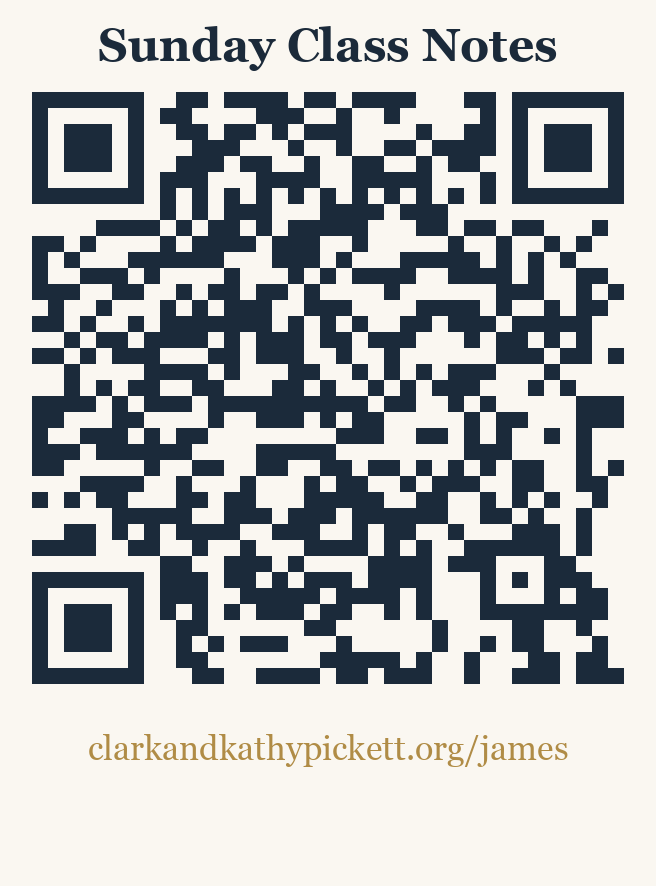
Follow along
Scan the code, or type the address into any browser.
clarkandkathypickett.org/james
These notes will stay online after class, so you can come back to them any time.
Coming up
James 3:1-18; 4:7-8 ·
How Do We Change the Fountain?
Cody Persell joins the class to take up the question James raises in chapter 3. The three questions we hope to explore, and time for discussion and for prayer with anyone who would like it.
Open the lesson notesEarlier lessons
James 3:2-18 ·
Changing the Fountain
How do we change the fountain? James answers three verses later: he names what is in it, where it comes from, and the fruit that shows it has changed. Prayer ministry, prophecy, and deliverance in their biblical place.
James 3:1 ·
Teachers, Greater Accountability, and the Qualifications for Elders
Beginning James 3. Why teachers are judged more strictly, what the New Testament elder lists add to that warning, and a companion study on reading a short phrase carefully.
James 2:18-20 ·
Dead Faith versus Living Faith
Lesson Two, Part Two. Faith becomes visible through what it does, why James chooses the demons as his illustration, and the difference between intellectual belief and saving faith.
James 2:14-17 ·
Can Faith Without Works Save?
Lesson Two, Part One. Why James begins with a hungry believer rather than with Abraham, the difference between claiming faith and living it, and what he means by dead faith.
James 2:1-13 ·
Living Faith Shows Mercy
The sin of partiality, the royal law, the law of liberty, and why mercy triumphs over judgment. The first of two lessons in James 2.
James 1:27 ·
How Jesus Interpreted the Old Testament
Does James mean only orphans and widows? That question opens into a larger one: the four complementary ways Jesus Himself read the Old Testament.
Class reference
David Pawson on James 2:14-26: Faith and Works
One of the finest Bible teachers of the last century on faith and works, in summary, in outline, and in full transcript, with a careful analysis of his strengths and his claims.
The Epistle of James: Author, Setting, and Early Reception
Who wrote the letter, who first received it, the world it was written into, and how the early church came to receive it as Scripture.
A word from Clark
Dear Friends,
As we continue our study of the book of James, much of the letter is very straightforward. During one of our early classes, however, an excellent question arose concerning James 1:27:
Does James literally mean only “orphans and widows,” or are they representative examples of a broader class of vulnerable people?
That question is really a doorway into a larger one: how did Jesus Himself interpret the Old Testament, and what can we learn from His example? My hope is that we will not only gain a better understanding of individual verses, but also become better students of God’s Word by learning from the greatest Interpreter of Scripture, our Lord Jesus Christ.
These notes are not a complete lesson on biblical interpretation. Rather, I hope they serve as a small step toward the goal Paul gave Timothy:
“Be diligent to present yourself approved to God, a worker who does not need to be ashamed, rightly dividing the word of truth.”2 Timothy 2:15
Blessings,
Clark
More teaching on how to read the Bible.
Articles, studies, and our approach to Scripture.