Sunday Morning Class · August 16, 2026
Can Faith Without Works Save?
James 2:14-17, Lesson Two, Part One. Saving faith is more than a profession of belief. It is a living trust in Christ that expresses itself through obedient love and practical action.
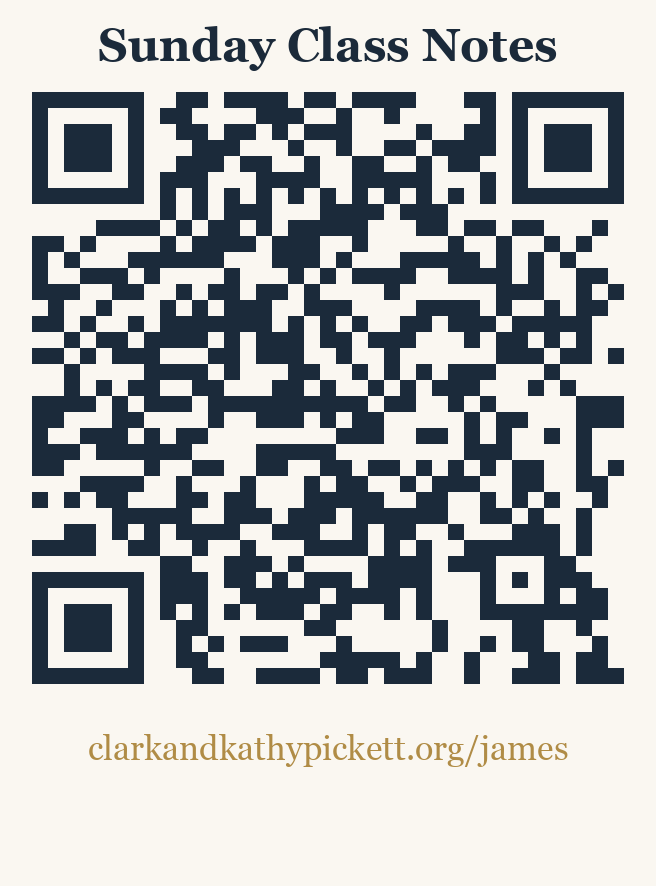
Follow along
Scan the code, or type the address into any browser.
clarkandkathypickett.org/james
These notes will stay online after class, so you can come back to them any time.
Lesson theme
Saving faith is more than a profession of belief. It is a living trust in Christ that inevitably expresses itself through obedient love and practical action.
Print the handout
A print-ready copy of this lesson, with room to write beside every discussion question.
Overview
Memory verse and lesson objectives
“Thus also faith by itself, if it does not have works, is dead.”
James 2:17 (NKJV)
Lesson objectives
By the end of today’s lesson, we should be able to:
- Explain why James begins his discussion of faith with a hungry believer rather than with Abraham.
- Distinguish between a claim of faith and living faith.
- Explain what James means by “dead faith.”
- Understand why verses 14-16 serve as the bridge between the two halves of James 2.
- Begin to see how James and Paul address different questions rather than contradicting one another.
Lesson overview
- Opening prayer and Scripture reading, James 2:14-17
- Part One, can that kind of faith save? James 2:14
- Part Two, the hungry brother or sister, James 2:15-16
- Part Three, faith without works is dead, James 2:17
- Challenge and closing prayer
The passage, James 2:14-17 (NLT)
14 What good is it, dear brothers and sisters, if you say you have faith but don’t show it by your actions? Can that kind of faith save anyone? 15 Suppose you see a brother or sister who has no food or clothing, 16 and you say, “Good-bye and have a good day; stay warm and eat well” but then you don’t give that person any food or clothing. What good does that do? 17 So you see, faith by itself isn’t enough. Unless it produces good deeds, it is dead and useless.
Opening prayer
Father, thank You for revealing Yourself through Your Word. As we continue studying James, help us move beyond merely agreeing with biblical truth to living it. Show us whether our faith is active, growing, and visible through love. Teach us to trust Christ so completely that our lives naturally reflect His character. May Your Holy Spirit give us understanding, conviction, and joyful obedience. In Jesus’ name, Amen.
Introduction
James begins with a hungry Christian
One of the greatest theological debates in Christian history centers around these verses. Questions such as these immediately arise:
- Can faith exist without works?
- Does James contradict Paul?
- Is James teaching salvation by works?
- What kind of faith actually saves?
These are important questions.
But James does not begin where many theologians begin.
- He does not begin with Abraham.
- He does not begin with Romans.
- He does not begin with justification.
Instead, James begins with a hungry Christian. That observation should shape the entire lesson.
Before James discusses theology, he asks a very practical question:
What happens when someone who claims to have faith meets a brother or sister in need?
James’ concern is profoundly pastoral. He wants believers to recognize that genuine faith is never merely something we say. It becomes something we live.
The bridge
How Lesson One leads into Lesson Two
Review of Lesson One
Living faith rejects partiality because God’s mercy changes how we see people. James 2:1-13 taught us:
- Faith and favoritism cannot comfortably exist together.
- Christians are called to obey the royal law: “Love your neighbor as yourself.”
- God’s people live under the law of liberty.
- Those who have received mercy should become merciful people.
James ended the first section with these powerful words: “Mercy triumphs over judgment.” Then, without changing subjects, James immediately presents an illustration.
The bridge between the two lessons
Notice what James does. He does not begin a brand-new topic. Instead, he takes the same needy believer from Lesson One and asks a new question.
Part One
Partiality → No mercy → Needy brother → Judgment
Part Two
Needy brother → Dead faith → Living faith → Works
The needy believer becomes the bridge between ethics and theology.
- Lesson One asked: How should Christians treat people?
- Lesson Two asks: What kind of faith produces that treatment?
The illustration is the same. The emphasis changes.
As we read James 2:14-17, listen for three repeated words: faith, works, and save. These become the key ideas of the passage.
Part One
Can that kind of faith save? (James 2:14)
“What does it profit, my brethren, if someone says he has faith but does not have works? Can faith save him?”
James 2:14
James begins with a profession, not with genuine faith. Notice the wording carefully. James does not say, “If someone has faith.” He says, “If someone says he has faith.”
James is testing a claim. This distinction is easy to miss, yet it is one of the most important observations in the chapter. The issue is not whether Christians should perform enough good works to earn salvation. The issue is whether a profession of faith that never produces obedience is truly saving faith.
Note
Many debates begin by asking, “Can works save?” James asks a different question: “Can that kind of faith save?” The emphasis falls upon the quality of the faith being claimed. James is examining the nature of faith itself.
Parallel Scriptures
- Matthew 7:21. “Not everyone who says to Me, ‘Lord, Lord,’ shall enter the kingdom of heaven.” Jesus also distinguishes between saying and doing.
- Luke 6:46. “Why do you call Me ‘Lord, Lord,’ and do not do the things which I say?”
- Titus 1:16. “They profess to know God, but in works they deny Him.” Again, profession and practice are compared.
Illustration
Imagine a fruit tree. Someone places a sign beside it that reads Apple Tree. Year after year, no apples appear. The sign claims one thing. The fruit says something else.
James is asking: what if someone’s life resembles that tree?
Discussion questions
- Why does James begin with “someone says” rather than “someone has”?
- Why are words alone insufficient evidence of saving faith?
- What kinds of religious claims are common today that may not be accompanied by transformed living?
Part Two
The hungry brother or sister (James 2:15-16)
James now returns to the illustration introduced in Lesson One. Notice the difference. Last week we asked, “Why should Christians help?” Today we ask, “What does refusing to help reveal about one’s faith?”
James says: suppose a brother or sister lacks daily food and adequate clothing. Someone responds, “Depart in peace. Be warmed. Be filled.” But gives nothing. James asks, “What does it profit?”
James is not criticizing kind words. He is criticizing kind words that substitute for loving action. The problem is not speech. The problem is empty speech.
Parallel Scripture
“Whoever has this world’s goods, and sees his brother in need, and shuts up his heart from him, how does the love of God abide in him? Let us not love in word or in tongue, but in deed and in truth.”
1 John 3:17-18
John and James teach the same principle. Love becomes visible.
Illustration
Suppose someone falls into a river. A crowd gathers. Everyone offers advice. Someone says, “I’ll pray for you.” Another says, “Stay strong.” Another says, “I hope everything works out.” Meanwhile, no one throws a rope.
James asks: what good were the words?
James is not saying Christians must give money indiscriminately. He is not discussing enabling irresponsibility, wise stewardship, long-term benevolence policies, or church budgets. His point is much simpler: real compassion acts.
Discussion questions
- Why is sympathy alone insufficient?
- Why does James choose a hungry Christian instead of Abraham as his first illustration?
- How does this illustration prepare us for everything that follows?
Part Three
Faith without works is dead (James 2:17)
“Thus also faith by itself, if it does not have works, is dead.”
James 2:17
Notice that James has not yet mentioned Abraham. He has not yet compared himself with Paul. He has not yet discussed justification. He first establishes one simple principle:
Living faith acts. Dead faith does not.
Everything that follows in the chapter illustrates this single truth.
Summary
James has not yet answered every theological question. He has simply shown us the first evidence of dead faith.
- A profession without obedience.
- Words without compassion.
- Belief without response.
These are not descriptions of living faith. They prepare us for Abraham and Rahab, whose faith became visible through costly obedience.
Close
Looking ahead, the challenge, and prayer
Looking ahead
Next week James will introduce two surprising examples. One is the father of Israel. The other is a Gentile prostitute. Abraham and Rahab could hardly be more different. Yet James says they have something profoundly important in common. Both possessed a faith that acted.
Challenge
Ask yourself this week:
If someone watched my life instead of listening to my words, what evidence would they find that I trust Christ?
Pray that God would make your faith increasingly visible through love, obedience, generosity, and humble service.
Closing prayer
Father, thank You that salvation is Your gift of grace through faith in Jesus Christ. Guard us from a faith that exists only in words. Produce within us a living faith that loves, serves, obeys, and trusts You. Help us become people whose lives point others to Christ because our actions reflect the mercy we ourselves have received. In Jesus’ name, Amen.
Other lessons in this class
- How Do We Change the Fountain?James 3:1-18; 4:7-8 · September 27, 2026
- Changing the FountainJames 3:2-18 · September 20, 2026
- Teachers, Greater Accountability, and the Qualifications for EldersJames 3:1 · September 6, 2026
- Dead Faith versus Living FaithJames 2:18-20 · August 30, 2026
- Living Faith Shows MercyJames 2:1-13 · August 9, 2026
- How Jesus Interpreted the Old TestamentJames 1:27 · August 2, 2026
More teaching on how to read the Bible.
Articles, studies, and our approach to Scripture.