Sunday Morning Class · October 11, 2026
Training the Tongue
Five questions for discussion, chosen from the Training the Tongue study guide. They move from the gift of speech to the real cost of telling the truth.
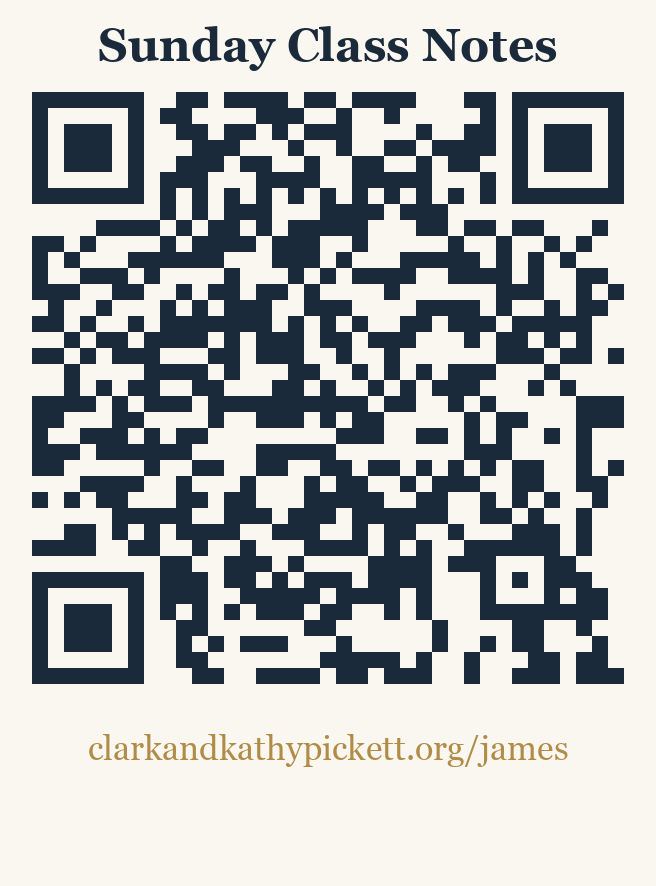
Follow along
Scan the code, or type the address into any browser.
clarkandkathypickett.org/james
These notes will stay online after class, so you can come back to them any time.
Five questions for class discussion
I selected five questions that seem especially biblically substantial, personally applicable, open-ended, and likely to generate good discussion without requiring overly private disclosure.
Reflect on the gift of speech. What are some of the blessings we see at work in the power of speech? What are some of the pitfalls?
This gives us the whole biblical picture. Speech is not merely a danger to control; it is a God-given capacity that can bless, teach, comfort, worship, reconcile, and build community. Yet the same faculty can also wound or deceive.
It fits especially well with the words of Jesus:
“Out of the abundance of the heart his mouth speaks.”
Luke 6:45
What two or three areas of speech do we need to work on?
This moves us from theory to self-examination. It could naturally lead into areas such as criticism, gossip, exaggeration, anger, sarcasm, listening, encouragement, or speaking too quickly.
What are some ways that we have seen the bonds of community forged or strengthened through the power of speech?
This moves beyond individual morality to the way our words affect the body of Christ and our relationships. We might think of examples involving encouragement, testimony, confession, forgiveness, teaching, prayer, or simply listening well.
What makes truthfulness a virtue? How can we actively cultivate it?
This asks not only whether Christians should tell the truth, but also why truthfulness is part of Christian character and how it can become habitual rather than merely an occasional act of will.
This gives us room to discuss Christ as truth, integrity, trust, the character of God, and practical ways to cultivate truthful speech.
In what ways do you think telling the truth makes life easier? In what ways do you think telling the truth makes life harder?
Truthfulness can simplify life because there is nothing to conceal or keep straight, but truth can also be costly. It may require confession, apology, disagreement, admitting ignorance, confronting wrongdoing, or accepting consequences.
That tension may lead to one of our richest discussions.
Where the questions lead
The sequence moves naturally from one to the next:
- 1God's gift
- 2Personal examination
- 3Relationships
- 4Christian virtue
- 5The real cost of obedience
The book and the study guide
The questions come from the study guide to Training the Tongue and Growing Beyond Sins of Speech. The publisher offers the guide as a free download on the same page as the book.
See the book and the free study guideOther lessons in this class
- How Do We Change the Fountain?James 3:1-18; 4:7-8 · September 27, 2026
- Changing the FountainJames 3:2-18 · September 20, 2026
- Teachers, Greater Accountability, and the Qualifications for EldersJames 3:1 · September 6, 2026
- Dead Faith versus Living FaithJames 2:18-20 · August 30, 2026
- Can Faith Without Works Save?James 2:14-17 · August 16, 2026
- Living Faith Shows MercyJames 2:1-13 · August 9, 2026
- How Jesus Interpreted the Old TestamentJames 1:27 · August 2, 2026
More teaching on how to read the Bible.
Articles, studies, and our approach to Scripture.