Sunday Morning Class · Reference
David Pawson on James 2:14-26
As we study faith and works in James 2, these materials let us hear one of the finest Bible teachers of the last century work through the same passage, and then weigh his teaching carefully, the way Bereans do.

Follow along
Scan the code, or type the address into any browser.
clarkandkathypickett.org/james
These notes will stay online after class, so you can come back to them any time.
Why this page
These materials allow us not only to hear Pawson’s interpretation but also to examine carefully his distinction between merely believing that certain Christian truths are true and genuinely believing in Christ through an active, trusting faith.
The teaching
David Pawson, James Part 6: Chapter 2 verse 14 to verse 26, Faith and Works Part 2, Theological.
Watch the video·davidpawson.org·davidpawson.co.uk
Clark enthusiastically recommends Pawson’s treatment of Scripture in general, and his book Unlocking the Bible, which walks through every book of the Bible in more than 1,300 pages. Pawson’s trust makes his teaching library freely available worldwide at the sites above.
The James charts
Pawson’s two Unlocking the Bible charts on James: first his impressions of the letter with its writer, style, and readers, and then its content and problem, where “works” means actions.
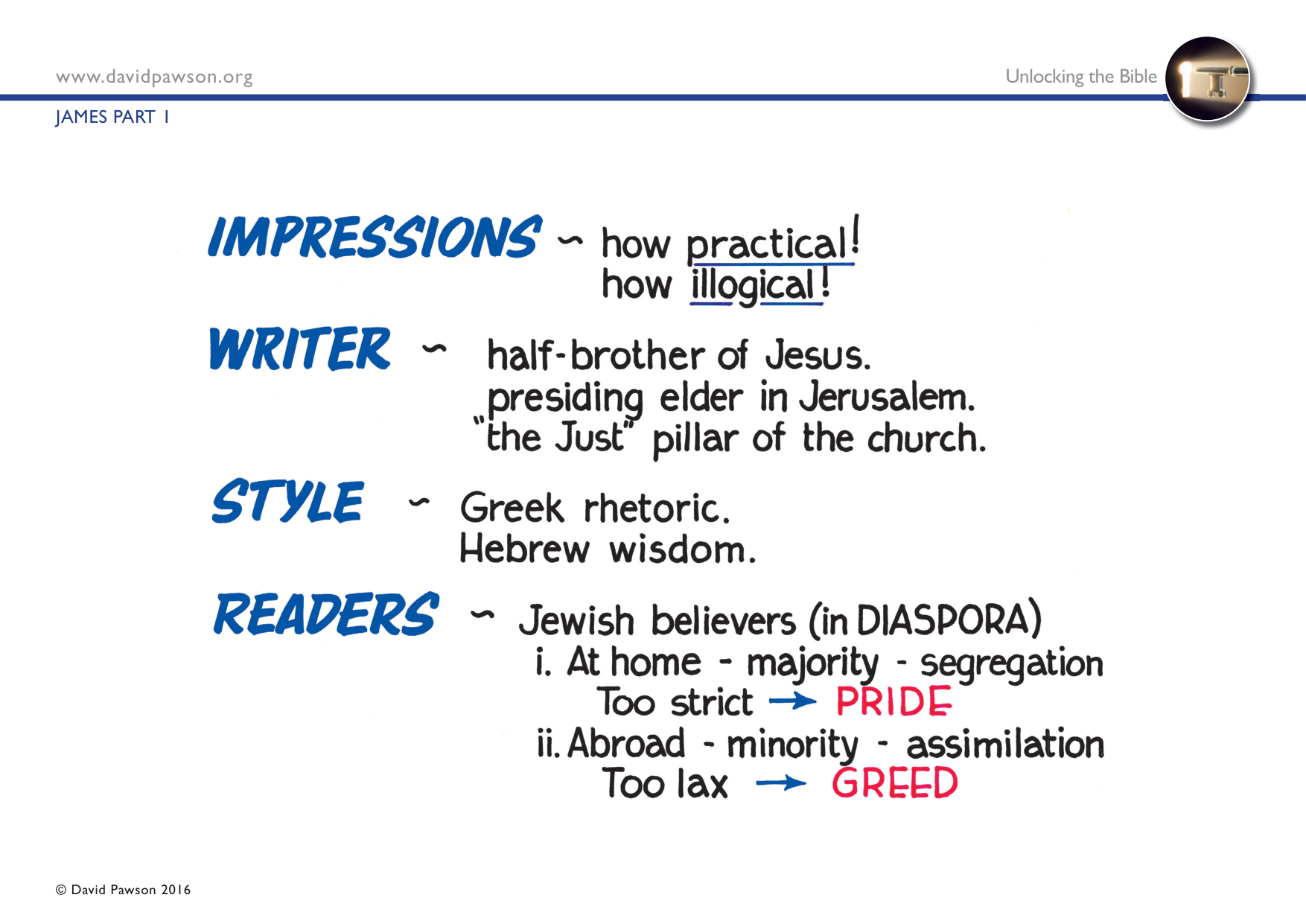
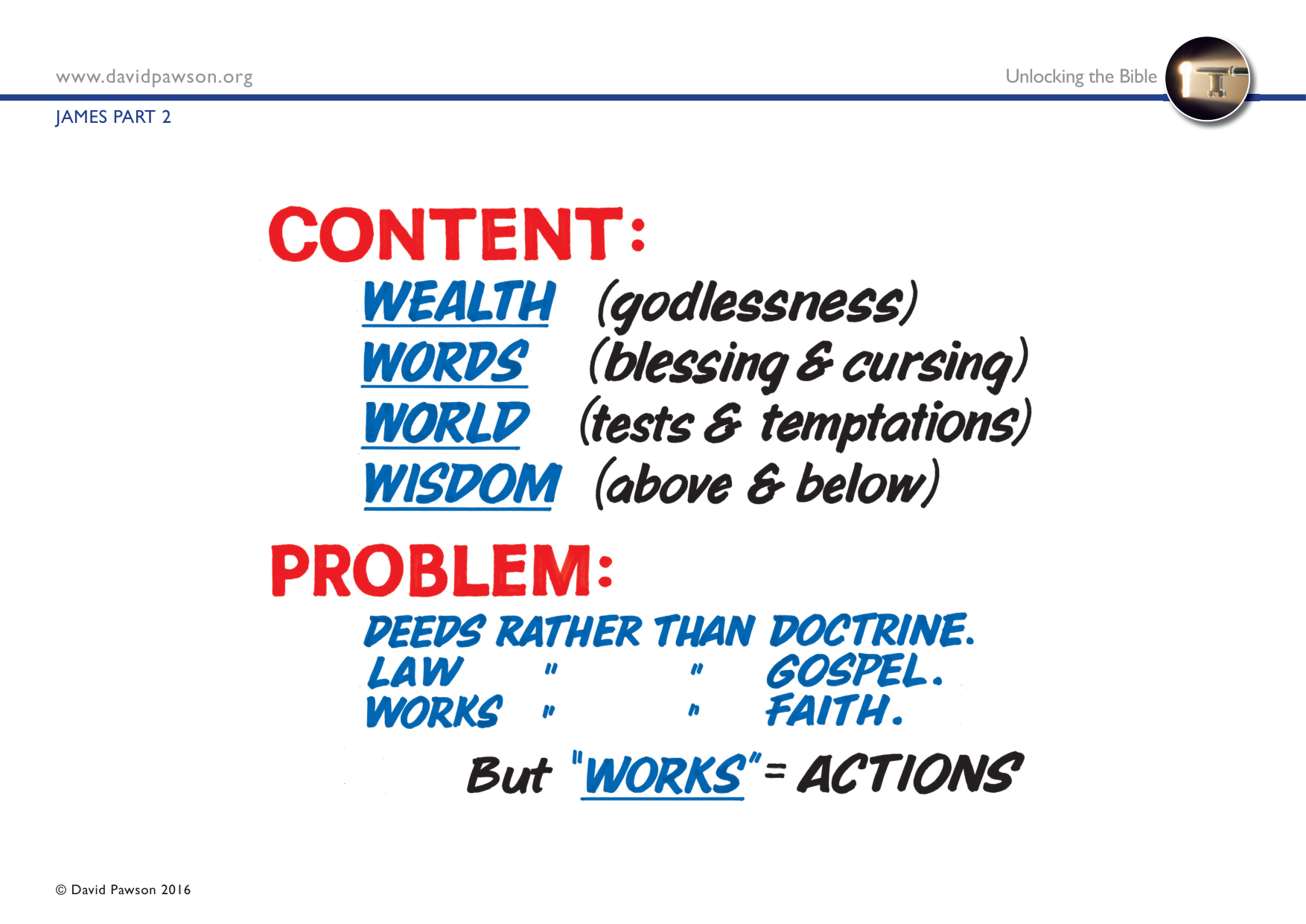
©David Pawson Ministry. Shared here, free of charge, with the ministry’s kind permission. The full set of Unlocking the Bible charts and diagrams is available at davidpawson.co.uk.
How these documents were prepared
The transcript began with an automatic transcription of the video by TurboScribe, then was formatted with the help of AI, with the intention of preserving all of Pawson’s original spoken content. The summary, outline, and analysis were likewise prepared with the help of AI from that transcript, and reviewed by Clark before posting. Automatic transcription may not be perfectly accurate; the video remains the authoritative record. How we use AI on this site.
The transcript and charts are posted with the ministry’s written permission and remain free of charge. ©David Pawson Ministry
Part One
The teaching in brief
A condensed summary for a first reading, before working through the longer outline below.
“David Pawson — James 2:14–26 Faith and Works, Part 2: Theological”
This teaching is especially important because Pawson is not merely explaining James 2:14–26; he is using the passage to challenge the common Protestant formulation of sola fide and to construct a broader theology of saving faith. He begins explicitly with the apparent conflict: Paul seems to teach justification by faith apart from works, while James repeatedly insists that faith without works cannot save.
Summary of the Teaching
Pawson sees James 2:14–26 as addressing one of Christianity's most consequential theological questions: What is saving faith?
He rejects three misunderstandings:
Works earn salvation.
Intellectual belief by itself constitutes saving faith.
James merely says that good deeds should appear sometime after justification as evidence that faith was genuine.
Instead, Pawson argues that James supplies something necessary to Paul's teaching.
Paul teaches that salvation cannot be earned by works.
James teaches that saving faith cannot remain without action.
Therefore, according to Pawson:
We are saved entirely by God's grace, but the faith through which grace is received must be active, trusting, obedient faith.
The “works” of James 2 are therefore not meritorious achievements that purchase God's favor. They are acts arising from faith that demonstrate and complete trust in God.
Abraham does not earn God's favor by offering Isaac. Rather, offering Isaac demonstrates that Abraham has moved from merely believing what God said to entrusting himself and his future to the God who said it.
I. Detailed Outline
1. The theological problem: Do Paul and James contradict each other?
Pawson begins with what he considers the central difficulty of James 2:14–26:
Paul appears to say that justification is by faith rather than works.
James appears to say that faith without works cannot save.
Both appeal to Abraham.
Both quote Genesis 15:6: Abraham believed God, and it was credited to him as righteousness.
Yet Pawson argues that they appear to use Abraham differently.
His controlling question is therefore:
“What must I do to be saved?”
For Pawson, this is not a peripheral theological disagreement. It concerns salvation itself.
2. Paul’s evidence
Pawson examines three Pauline passages:
Romans 4:1–2
Abraham was not justified by works.
Abraham believed God, and righteousness was credited to him.
Galatians 3:6–8
Again Paul appeals to Genesis 15:6.
Those who have faith are children of Abraham.
Ephesians 2:8–10
Salvation is by grace through faith.
It is not from works.
Nevertheless, believers are created in Christ for good works.
Pawson sees a genuine tension rather than dismissing the problem.
II. Pawson's Historical Framework
3. Augustine, Pelagius, and the middle position
Pawson therefore insists simultaneously:
No one can save himself, earn salvation, or deserve salvation — but grace must nevertheless be received and acted upon.
4. The Reformation and sola fide
5. Perseverance and “once saved, always saved”
6. Pentecost as an example of human response
III. Three Proposed Solutions to Paul and James
Pawson organizes the heart of the teaching around three possibilities.
7. Solution One — Contradiction
8. Ephesians 2:8 and the “gift of God”
9. Solution Two — Compatibility: Paul and James mean essentially the same thing
IV. Pawson's Solution — Complementarity
10. Paul and James are neither contradictory nor identical
V. Pawson's Central Interpretation of James 2
11. “Works” means works of faith
VI. “Believing That” versus “Believing In”
VII. Profession, Possession, and Practice
Part Two
Summary and detailed outline
The full summary and outline of the teaching, section by section.
“David Pawson — James 2:14–26 Faith and Works, Part 2: Theological”
This teaching is especially important because Pawson is not merely explaining James 2:14–26; he is using the passage to challenge the common Protestant formulation of sola fide and to construct a broader theology of saving faith. He begins explicitly with the apparent conflict: Paul seems to teach justification by faith apart from works, while James repeatedly insists that faith without works cannot save.
Summary of the Teaching
Pawson sees James 2:14–26 as addressing one of Christianity's most consequential theological questions: What is saving faith?
He rejects three misunderstandings:
Works earn salvation.
Intellectual belief by itself constitutes saving faith.
James merely says that good deeds should appear sometime after justification as evidence that faith was genuine.
Instead, Pawson argues that James supplies something necessary to Paul's teaching.
Paul teaches that salvation cannot be earned by works.
James teaches that saving faith cannot remain without action.
Therefore, according to Pawson:
We are saved entirely by God's grace, but the faith through which grace is received must be active, trusting, obedient faith.
The “works” of James 2 are therefore not meritorious achievements that purchase God's favor. They are acts arising from faith that demonstrate and complete trust in God.
Abraham does not earn God's favor by offering Isaac. Rather, offering Isaac demonstrates that Abraham has moved from merely believing what God said to entrusting himself and his future to the God who said it.
I. Detailed Outline
1. The theological problem: Do Paul and James contradict each other?
Pawson begins with what he considers the central difficulty of James 2:14–26:
Paul appears to say that justification is by faith rather than works.
James appears to say that faith without works cannot save.
Both appeal to Abraham.
Both quote Genesis 15:6: Abraham believed God, and it was credited to him as righteousness.
Yet Pawson argues that they appear to use Abraham differently.
His controlling question is therefore:
“What must I do to be saved?”
For Pawson, this is not a peripheral theological disagreement. It concerns salvation itself.
2. Paul’s evidence
Pawson examines three Pauline passages:
Romans 4:1–2
Abraham was not justified by works.
Abraham believed God, and righteousness was credited to him.
Galatians 3:6–8
Again Paul appeals to Genesis 15:6.
Those who have faith are children of Abraham.
Ephesians 2:8–10
Salvation is by grace through faith.
It is not from works.
Nevertheless, believers are created in Christ for good works.
Pawson sees a genuine tension rather than dismissing the problem.
II. Pawson's Historical Framework
3. Augustine, Pelagius, and the middle position
Pawson frames the controversy in terms of the relative roles of divine grace and human response.
He presents three positions:
Pawson explicitly places himself in the third category:
“I come firmly in the middle with the French bishops.”
His illustration is memorable:
Augustinian: we have already drowned and God must rescue us.
Middle position: we are drowning; God throws the lifeline, but we must grab it.
Pelagian: we are capable swimmers who simply need to swim ashore.
Pawson therefore insists simultaneously:
No one can save himself, earn salvation, or deserve salvation — but grace must nevertheless be received and acted upon.
4. The Reformation and sola fide
Pawson then moves to Luther and Calvin.
His key contention is that the Reformers added the word “alone” to Paul's teaching:
sola fide — “faith alone.”
He emphasizes that Paul himself never uses the expression “faith alone,” whereas James does—and James says that justification is not by faith alone.
This becomes one of Pawson's major arguments:
“It's assuming that Paul said alone that is the heart of the apparent contradiction. Paul never did say faith alone.”
5. Perseverance and “once saved, always saved”
Pawson connects the same theological issue with eternal security.
His reasoning is:
If salvation is entirely God's action, then perseverance will likewise be entirely God's action.
He therefore associates Calvinism with:
election,
divine preservation,
perseverance of the saints,
and what is popularly called “once saved, always saved.”
Pawson rejects unconditional eternal security and states that he believes Christians have a responsibility to maintain their side of the relationship.
6. Pentecost as an example of human response
Pawson turns to Acts 2.
The crowd asks:
“What must we do?”
Peter does not answer, in Pawson's reading, “Nothing; simply wait for God to act.”
Instead:
repent,
be baptized,
receive forgiveness.
This fits Pawson's emphasis on “do” as a major word in James.
His formula becomes:
God will do what only God can do, but human beings must make the response God requires.
III. Three Proposed Solutions to Paul and James
Pawson organizes the heart of the teaching around three possibilities.
7. Solution One — Contradiction
Perhaps James and Paul actually contradict one another.
Pawson rejects this because he accepts both as inspired Scripture.
He says that people who choose one over the other tend to fall into opposite errors:
emphasizing human works and merit;
or emphasizing faith in a way that removes meaningful human response.
His memorable definition of grace is:
“Your bad deeds needn't keep you out of heaven, but your good deeds won't help you to get there.”
Good works cannot earn salvation.
But that does not mean that salvation requires no human response.
8. Ephesians 2:8 and the “gift of God”
Pawson challenges a common interpretation of Ephesians 2:8.
He argues that:
“this is not from yourselves, it is the gift of God”
refers to salvation, rather than specifically to faith.
Thus Pawson says:
“You do the believing and he'll do the saving.”
He therefore strongly rejects the idea that saving faith must itself be irresistibly created in a person before that person can believe.
9. Solution Two — Compatibility: Paul and James mean essentially the same thing
Pawson next considers the standard evangelical reconciliation:
Paul: We are justified by faith, not works.
James: Genuine saving faith subsequently produces good works.
Thus:
We are not saved by good works, but we are saved for good works.
Pawson acknowledges that this is the interpretation found in many evangelical commentaries.
But he thinks it does not go far enough.
Why?
Because, in his reading, James is not simply talking about charitable “good works.”
He is talking about “works of faith.”
Abraham offering Isaac and Rahab receiving and protecting the spies are not primarily examples of benevolent deeds. They are actions arising from trust in God.
This distinction is essential to Pawson's interpretation.
IV. Pawson's Solution — Complementarity
10. Paul and James are neither contradictory nor identical
Pawson's preferred solution is:
Paul and James are complementary.
They are not:
A. Contradictory — saying opposite things.
Nor are they simply:
B. Compatible — saying essentially the same thing in different language.
Rather:
C. Complementary — each contributes something the other does not emphasize.
Pawson states:
“James is adding a dimension to saving faith which Paul did not include in all that he said about faith.”
His hermeneutical principle is therefore important:
A complete New Testament doctrine must be constructed from the whole New Testament rather than forcing one biblical writer into the theological categories of another.
V. Pawson's Central Interpretation of James 2
11. “Works” means works of faith
This is arguably the most important interpretive move in the entire teaching.
Pawson distinguishes:
Good works
kindness,
charity,
moral behavior,
benevolent actions.
from:
Works of faith
actions performed because one trusts God,
actions that put faith into practice,
actions involving reliance upon God.
Thus Abraham offering Isaac is a work of faith.
Rahab protecting the spies is a work of faith.
James is therefore contrasting:
faith that does not work
with
faith that works.
Pawson summarizes:
“Saving faith is faith that works.”
VI. “Believing That” versus “Believing In”
This is perhaps Pawson's clearest pastoral explanation.
He distinguishes between:
Believing that
This involves content.
A person believes:
Jesus existed.
Jesus died.
Jesus rose.
Jesus ascended.
Jesus will return.
One can affirm the creed and possess orthodox Christian beliefs.
But Pawson argues that this can remain purely intellectual.
Believing in
This involves confidence/trust.
A person entrusts something to Christ.
Faith becomes active.
Pawson illustrates this with the wealthy woman in Hanover. She could believe that Pawson existed without trusting him with her money.
Thus:
Believing that = accepting propositions as true.
Believing in = personally entrusting oneself to someone.
For Pawson, James insists that saving faith must contain both.
VII. Profession, Possession, and Practice
Pawson develops this into three useful categories:
Profession of faith
“I believe in Jesus.”
Possession of faith
The person genuinely trusts Christ.
Practice of faith
The person's actions demonstrate that trust.
He asks his listeners:
“When did you first believe in Jesus?”
But then changes the question:
“When did you first practice faith?”
And later:
“When did you last believe in Jesus?”
The point is not merely whether one once professed Christianity.
The question is whether faith remains living and active.
Pawson therefore contrasts:
Dead faith
→ words
→ intellectual assent
→ profession
→ believing that
with:
Living faith
→ deeds
→ trust
→ action
→ believing in
He concludes:
“It's not just accepting truth. It's trust as well.”
And finally:
“What makes faith a living and a saving faith is what you do about it.”
Part Three
A careful analysis
Clark especially recommends this analysis. It appreciates Pawson’s principal insights and also weighs some of his theological and historical claims, which is exactly how he would want us to receive any teacher, himself included.
“David Pawson — James 2:14–26 Faith and Works, Part 2: Theological”
1. Pawson's strongest exegetical insight: “works of faith”
This is the most fruitful part of the teaching.
Pawson rightly notices that Abraham and Rahab matter enormously to James's argument. If James merely meant “do charitable deeds,” Abraham's offering of Isaac would be a strange culminating example.
Pawson therefore asks us to understand erga (“works”) contextually as actions arising from faith.
That gives considerable force to James 2:22:
Abraham's faith was working together with his works, and by the works his faith was completed.
Pawson takes “completed” very seriously.
Faith does not merely sit behind the action as an invisible reality whose authenticity is subsequently demonstrated. In Pawson's interpretation, faith reaches its intended completeness through obedient action.
2. Pawson's distinction between “believing that” and “believing in” is excellent pedagogically
This is probably the most useful part of the teaching for a Bible-study class.
James himself makes essentially this distinction through the demons:
They have correct theology.
They know that God is one.
But their correct belief does not constitute saving faith.
Pawson therefore makes an important distinction between:
orthodoxy → “I believe this is true”
and
trust → “I am staking myself upon its truth.”
That captures an important dimension of the biblical concept of faith.
3. His treatment of Paul and James is deliberately different from the usual evangelical reconciliation
The common Protestant explanation is approximately:
Paul opposes works as the basis of justification, whereas James opposes a false faith that produces no works.
Pawson thinks that explanation makes James too Pauline.
He wants James to make a genuinely additional theological contribution.
Thus his word “complementary” is crucial.
For Pawson:
Paul asks: How can salvation be received without earning it?
James asks: What kind of faith actually saves?
That formulation goes a considerable way toward reconciling the two writers without making them say precisely the same thing.
4. Pawson's historical treatment needs more qualification
This is where I would distinguish most carefully between Pawson's theological argument and a consensus historical account.
His presentation of Augustine, Pelagius, the “French bishops,” Luther, Calvin, the Anabaptists, Wesley, Whitefield, and modern Reformed theology is intentionally simplified. Pawson himself acknowledges this:
“I'm simplifying this to try and make it clear to you.”
That warning is important.
For example, classical Reformed theology would strongly reject the characterization that human beings have nothing to do in conversion in the ordinary sense. Reformed theologians command people to repent and believe; their disagreement with Pawson concerns the ultimate source and efficacy of that repentance and faith.
Likewise, historic sola fide normally does not mean:
“Intellectual belief alone saves regardless of the subsequent life.”
The classic Protestant formula is closer to:
We are justified by faith alone, but the faith that justifies is never alone.
That is much closer to James than Pawson's critique of some popular evangelical presentations might initially suggest.
5. A particularly important point requiring qualification: “faith alone”
Pawson is correct in the narrow verbal observation that James 2:24 is the New Testament passage explicitly juxtaposing justification with “faith alone.”
But historically, sola fide was intended to answer a particular question:
What is the instrumental means by which a sinner is justified before God?
It was not intended to define saving faith as mere intellectual assent.
Therefore, Pawson is strongest when attacking the popular idea:
“I mentally accepted Jesus at some point, therefore nothing I subsequently do can have any bearing upon whether my faith is living or dead.”
He is less decisive if his argument is taken as disproving the more carefully formulated Protestant doctrine of justification by faith alone.
6. The Abraham chronology is the crucial theological issue
Pawson identifies something genuinely important.
Genesis 15:6 says:
Abraham believed God → it was credited to him as righteousness.
Genesis 22 occurs much later:
Abraham offers Isaac.
Paul emphasizes Genesis 15.
James brings Genesis 15 together with Genesis 22.
Pawson therefore sees James saying that Abraham's earlier faith reached completion in the later act of obedience.
This is the place where the major interpretations diverge.
A traditional Reformed interpretation would say:
Genesis 15: Abraham is justified.
Genesis 22: Abraham's already-existing justifying faith is demonstrated/vindicated as genuine.
Pawson's interpretation is stronger:
Genesis 15 → faith begins
Genesis 22 → faith acts and is completed
therefore the action belongs intrinsically to the saving character of faith itself.
That distinction is probably the single most important theological question to raise when discussing Pawson's teaching.
7. A useful synthesis for James 2:14–26
Even without accepting every element of Pawson's historical or systematic theology, his central insight can be stated in a way that preserves much of its force:
James is not teaching salvation by meritorious good deeds. He is teaching that the faith that saves is a faith that acts.
Or even more simply:
Paul:
Works cannot replace faith.
James:
Works cannot be removed from living faith.
That formulation preserves Paul's rejection of merit while retaining James's uncompromising declaration:
“Faith without works is dead.”
Part Four
The full transcript
The complete formatted transcript of the teaching is on its own page. It can be read more quickly than the video can be watched, and it makes it easy to return to particular portions after watching.
Other lessons in this class
- How Do We Change the Fountain?James 3:1-18; 4:7-8 · September 27, 2026
- Changing the FountainJames 3:2-18 · September 20, 2026
- Teachers, Greater Accountability, and the Qualifications for EldersJames 3:1 · September 6, 2026
- Dead Faith versus Living FaithJames 2:18-20 · August 30, 2026
- Can Faith Without Works Save?James 2:14-17 · August 16, 2026
- Living Faith Shows MercyJames 2:1-13 · August 9, 2026
- How Jesus Interpreted the Old TestamentJames 1:27 · August 2, 2026
More teaching on how to read the Bible.
Articles, studies, and our approach to Scripture.