Sunday Morning Class · Reference
The Epistle of James
Who wrote this letter, who first received it, the world it was written into, and how the early church came to receive it as Scripture. A background page for our study, to read alongside the weekly lessons.
Follow along
Scan the code, or type the address into any browser.
clarkandkathypickett.org/james
These notes will stay online after class, so you can come back to them any time.
Why this page
James calls believers to a faith that is genuine, compassionate, and active. Knowing who wrote the letter, and how the church came to receive it, helps us read it with more confidence and more care.
Prefer it on paper?
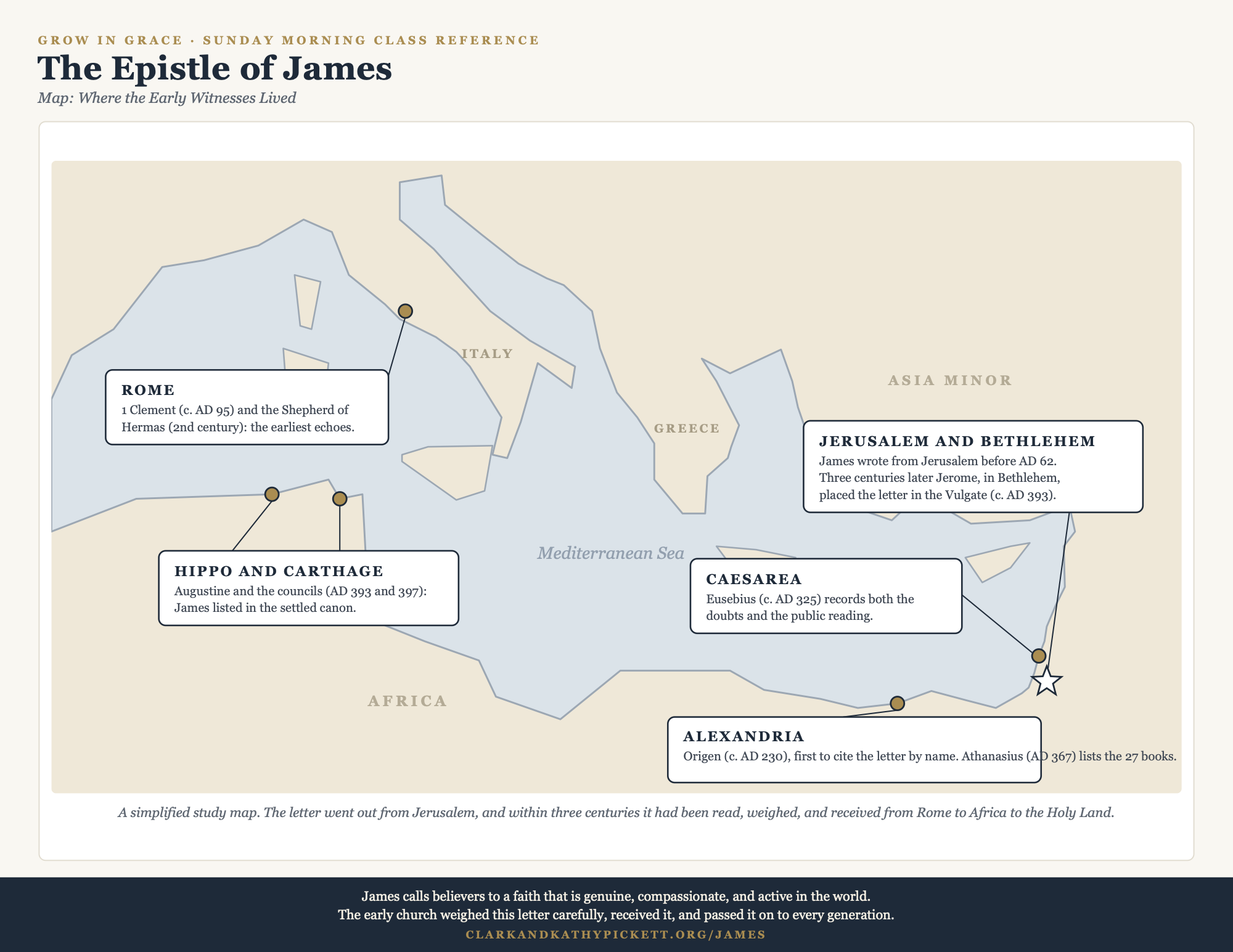
This material is also a printable chart, with a map of where the early witnesses lived.
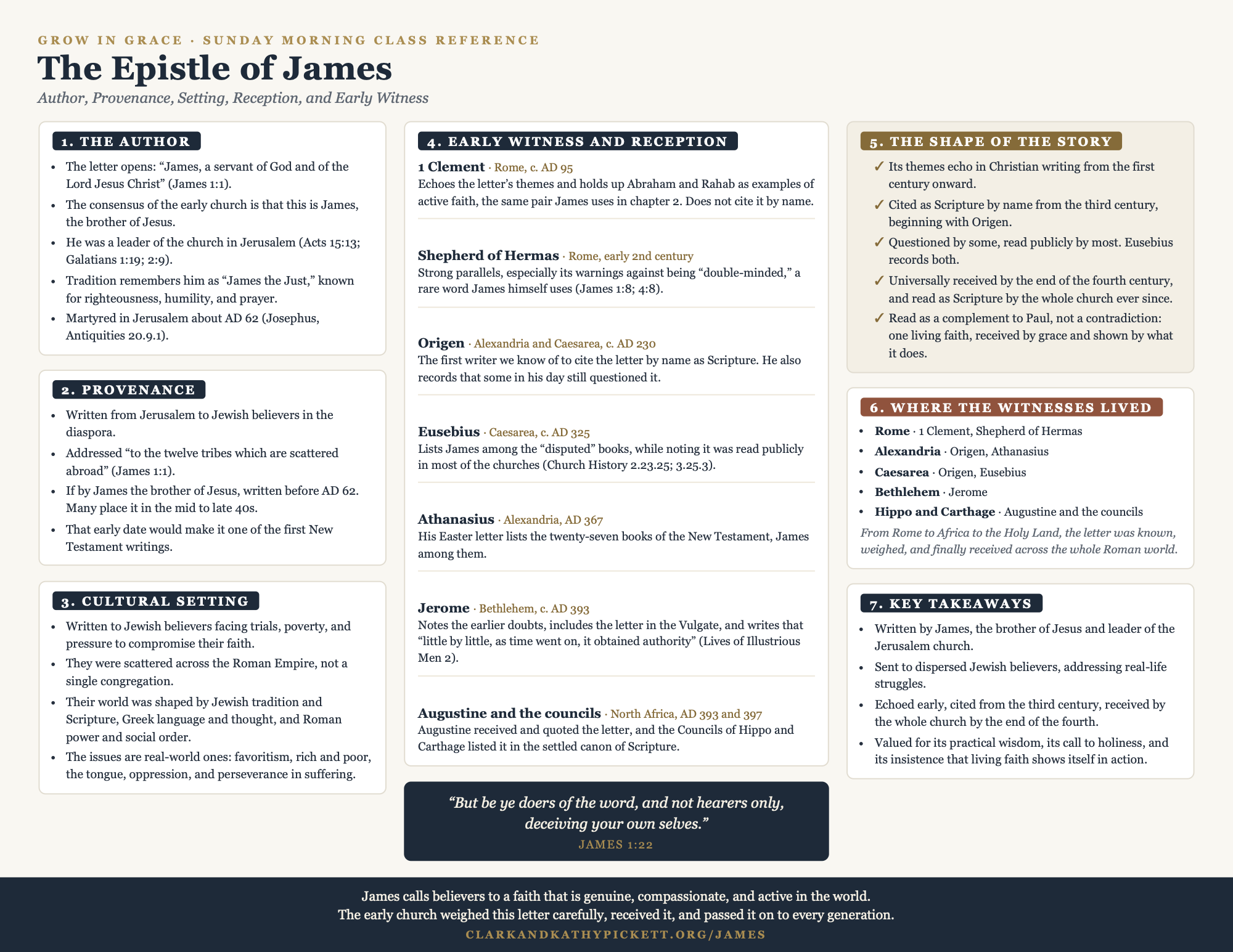
The letter opens simply: “James, a servant of God and of the Lord Jesus Christ” (James 1:1). The consensus of the early church, and of most students of the letter since, is that this is James the brother of Jesus.
- He was a leader of the church in Jerusalem, presiding at the Jerusalem council (Acts 15:13) and named by Paul among the pillars of the church (Galatians 1:19; 2:9).
- Tradition remembers him as “James the Just,” known for his righteousness, humility, and constancy in prayer.
- He was martyred in Jerusalem around AD 62. The Jewish historian Josephus records his death by stoning (Antiquities 20.9.1).
Part Two
To whom, from where, and when
- The letter is addressed “to the twelve tribes which are scattered abroad” (James 1:1): Jewish believers dispersed beyond the land of Israel.
- It was almost certainly written from Jerusalem, where James lived and ministered.
- If James the brother of Jesus is the author, the letter was written before AD 62. Many students of the letter place it in the mid to late 40s, which would make it one of the earliest writings in the New Testament.
Part Three
The world the letter was written into
James wrote to scattered congregations of Jewish believers facing trials, poverty, and pressure to compromise their faith. Their world was shaped by Jewish tradition and Scripture, by Greek language and culture, and by the power and social order of Rome.
The issues the letter addresses reflect that real world: favoritism toward the rich, contempt for the poor, an unruly tongue, economic oppression, and the daily work of persevering in suffering. James is not an abstract essay. It is pastoral counsel for believers under pressure.
Part Four
How the early church received it
The letter’s path into the settled canon of the New Testament was quieter and slower than that of the Gospels or Paul’s letters, and it is worth telling honestly, because the story ends in a strong and settled confidence.
1 Clement
Rome, about AD 95
This early letter from the church in Rome never names the epistle, but it moves in the same world: it prizes humility and endurance, and it holds up Abraham and Rahab as examples of faith shown in action, the same pair James uses in chapter 2.
The Shepherd of Hermas
Rome, early second century
A widely read early Christian work with strong parallels to James, especially its warnings against being double-minded. That rare word is one James himself uses (James 1:8; 4:8).
Origen
Alexandria and Caesarea, about AD 230
The first Christian writer we know of to cite the letter by name as Scripture, quoting it often as the epistle of James. He also honestly records that some in his day still questioned it.
Eusebius
Caesarea, about AD 325
In his Church History he lists James among the disputed books, the writings some churches questioned, while noting that it was openly read in most of the churches (Church History 2.23.25; 3.25.3).
Athanasius
Alexandria, AD 367
His Easter letter for that year lists the twenty-seven books of our New Testament, James among them, as the writings handed down and received by the church.
Jerome
Bethlehem, about AD 393
He records that some had doubted the letter's authorship, yet he included it in his Latin translation, the Vulgate, and wrote that little by little, as time went on, it obtained authority (Lives of Illustrious Men 2).
Augustine and the councils
North Africa, AD 393 and 397
Augustine received and quoted the letter, and the Councils of Hippo and Carthage listed it in the settled canon of Scripture.
Part Five
The shape of the story
- In the first and second centuries the letter’s themes echo through early Christian writing, though no one yet cites it by name.
- From the third century onward it is quoted openly as Scripture, beginning with Origen.
- Some in the early church questioned it, largely because it was brief, it named its author so simply, and it had circulated more narrowly than Paul’s letters. Eusebius records both the questions and the fact that most churches read it publicly.
- By the end of the fourth century the question was settled. Athanasius, Jerome, Augustine, and the councils of the era all received it, and the whole church has read it as Scripture ever since.
- The early church did not read James as a contradiction of Paul. Paul writes against works as the ground of our standing with God; James writes against a faith that produces nothing. Together they describe one living faith: received by grace, and shown by what it does.
“But be ye doers of the word, and not hearers only, deceiving your own selves.”James 1:22
Reference
Key takeaways
- Written by James, the brother of Jesus and leader of the Jerusalem church, most likely before AD 62.
- Sent to dispersed Jewish believers, addressing the real struggles of daily life under pressure.
- Echoed early, cited as Scripture from the third century, and received by the whole church by the end of the fourth.
- Valued then and now for its practical wisdom, its call to holiness, and its insistence that living faith shows itself in action.
Other lessons in this class
- How Do We Change the Fountain?James 3:1-18; 4:7-8 · September 27, 2026
- Changing the FountainJames 3:2-18 · September 20, 2026
- Teachers, Greater Accountability, and the Qualifications for EldersJames 3:1 · September 6, 2026
- Dead Faith versus Living FaithJames 2:18-20 · August 30, 2026
- Can Faith Without Works Save?James 2:14-17 · August 16, 2026
- Living Faith Shows MercyJames 2:1-13 · August 9, 2026
- How Jesus Interpreted the Old TestamentJames 1:27 · August 2, 2026
More teaching on how to read the Bible.
Articles, studies, and our approach to Scripture.